Kitchen Lighting Fixtures That Transform the Whole Room — and Yes, It Really Is That Simple

The kitchen in our Temecula house has always bothered me, but I couldn’t put my finger on why. It’s not particularly small — Frank measured it himself when we moved in — but it always felt cramped, especially in the evenings when I’d be cleaning up after dinner.
Then one Tuesday morning while making coffee, I realized what the problem was. We had one ceiling fixture in the center of the room, casting shadows into every corner where I actually needed to see.
If your kitchen feels tighter than it should, or darker than makes sense, you’re probably dealing with the same lighting mistake we were.
Here are 22 kitchen lighting ideas that actually work to open up your space — no renovation required for most of them.
What Actually Makes A Kitchen Feel Bigger?
The answer isn’t brighter bulbs. It’s spreading light around so you don’t have those dark pockets that make walls feel closer than they are.
You need light coming from different places — not just overhead. Add some under-cabinet strips to brighten your counters. Put in a few recessed lights if you can manage it.
Choose fixtures that let light through instead of blocking it — clear glass, open frames, anything that doesn’t trap the brightness inside a heavy shade.
Warm white bulbs around 3000K work better than those harsh daylight ones that make everything look like a doctor’s office. Trust me on this.
Save this article for later! 👇👇
Layered Glow
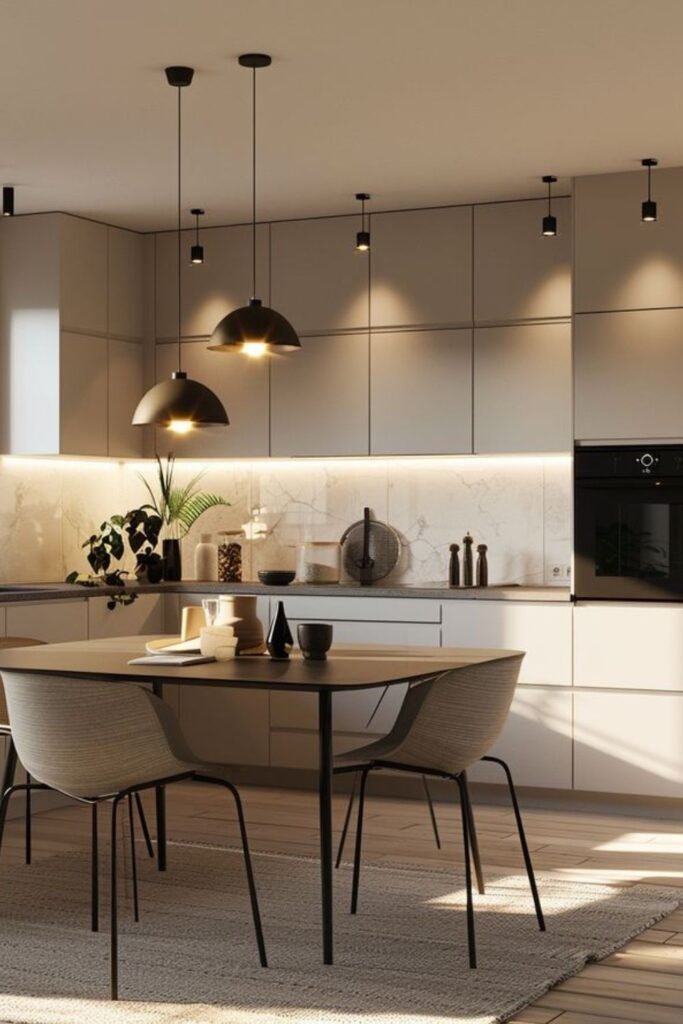
One overhead light makes even the nicest kitchen look flat. What you see here is different sources working together — recessed spots in the ceiling, LED strips under the cabinets, and two simple pendant lights over the table.
The under-cabinet lighting is what really makes the difference. It eliminates that shadow line where your upper cabinets meet the backsplash, which immediately makes the room feel more open.
If you’re going to add recessed lights, space them evenly instead of cramming them all in the center. The goal is soft, even coverage, not spotlights.
Those matte black pendants with gold interiors do something smart — they send light straight down where you need it, but the reflective inside bounces it back up too. Warm white bulbs keep everything feeling comfortable rather than sterile.
Hidden Illumination
This is what I wish we’d done when we first moved in. Light coming from places you don’t immediately notice — under the cabinets, along the ceiling edges, even under the island base.
It makes the whole room feel like it’s glowing instead of being lit. The island appears to float because of that toe-kick lighting underneath, which is a lot more sophisticated than I expected when my friend Donna told me about it.
LED strips are easier to install than you’d think, especially the battery-operated ones if you don’t want to deal with wiring. Frank managed our under-cabinet lighting on a Saturday afternoon with a drill and some patience.
The trick is keeping the color temperature consistent across all your hidden lights. Mix warm and cool whites and it’ll look like a mistake rather than a design choice.
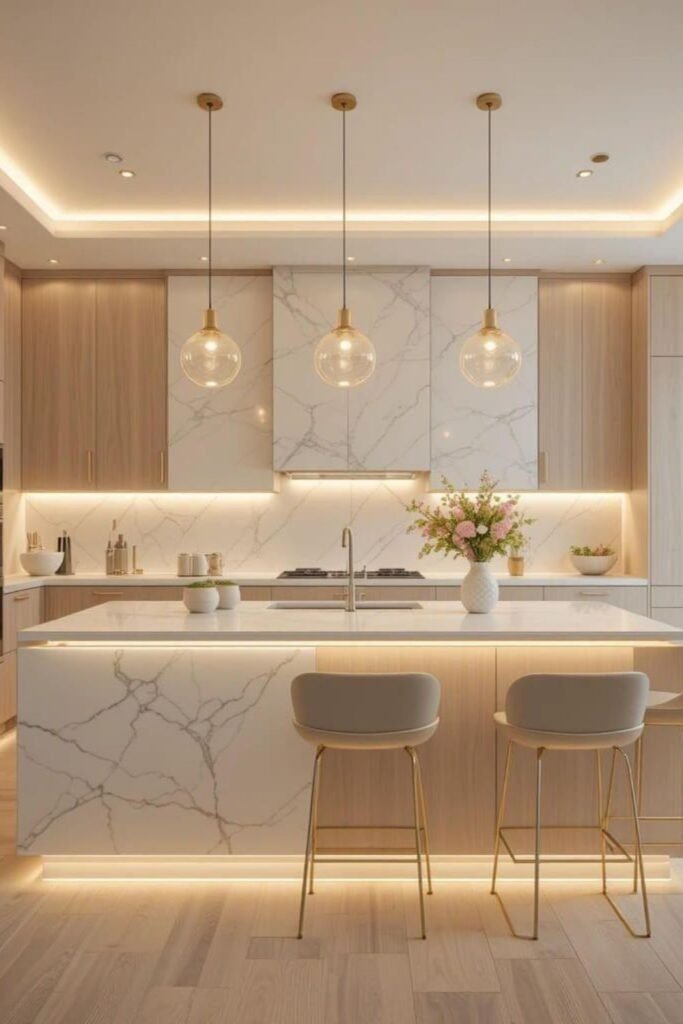
Globe Pendants
Heavy lampshades make a room feel smaller without you even realizing it. These thin glass globes do the opposite — they let light spread in every direction while still looking intentional over the island.
The vertical brass rods draw your eye upward, which makes the ceiling feel higher than it actually is. It’s a small thing, but it works.
If you’re replacing bulky pendants, go for something with clear or frosted glass and minimal hardware. Multiple small globes on one fixture feels more interesting than three separate lights, and it’s usually less expensive too.
Hang them about 32 inches above your counter — high enough that tall people won’t hit their heads, low enough to actually light the workspace.
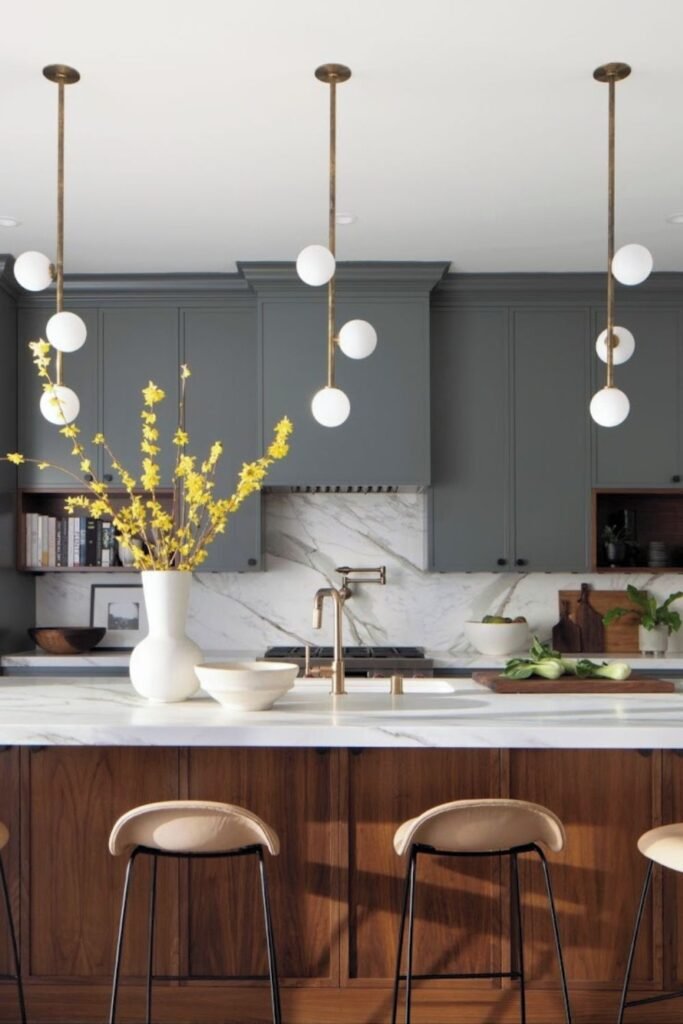
Statement Balance
Sometimes you need larger fixtures to fill the space above a big island. These white drum pendants have the right scale without feeling heavy because light escapes from both the bottom and the top.
That upward light bounces off the ceiling and spreads back down, which is more useful than you’d expect. The brass details add warmth without making the whole kitchen feel yellow.
Two bigger pendants usually look better than three smaller ones over a wide island. It’s cleaner and less cluttered.
Keep the shades light colored so they reflect light instead of absorbing it. White or cream works, but avoid anything too dark unless you want the fixtures to disappear into shadow at night.
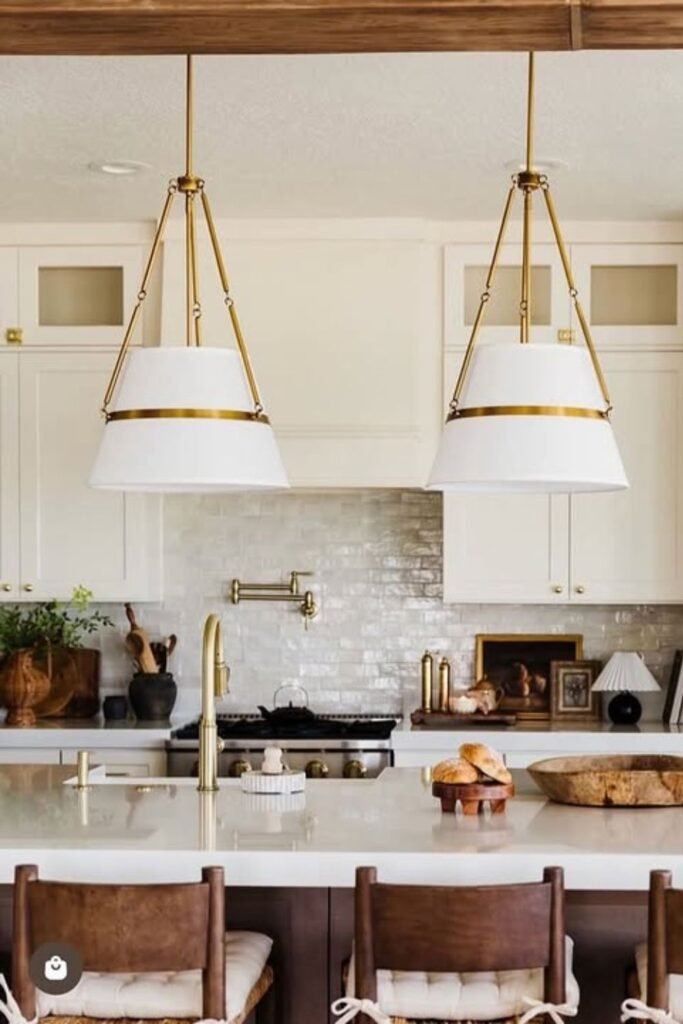
Soft Diffusion
White kitchens can look washed out if your lighting is too harsh. Frosted glass pendants solve that by spreading light evenly instead of creating bright spots and dark corners.
The brass hardware keeps it from looking cold, which is important when everything else in the room is white. I’ve seen all-white kitchens that feel like laboratories, and it’s usually because the lighting is wrong.
Three evenly spaced fixtures work well over a long island — just make sure they’re properly centered. Nothing looks more amateur than pendants that are obviously off-center.
Milky glass is forgiving. It hides dust better than clear glass and doesn’t show water spots if you happen to splash them while washing dishes.
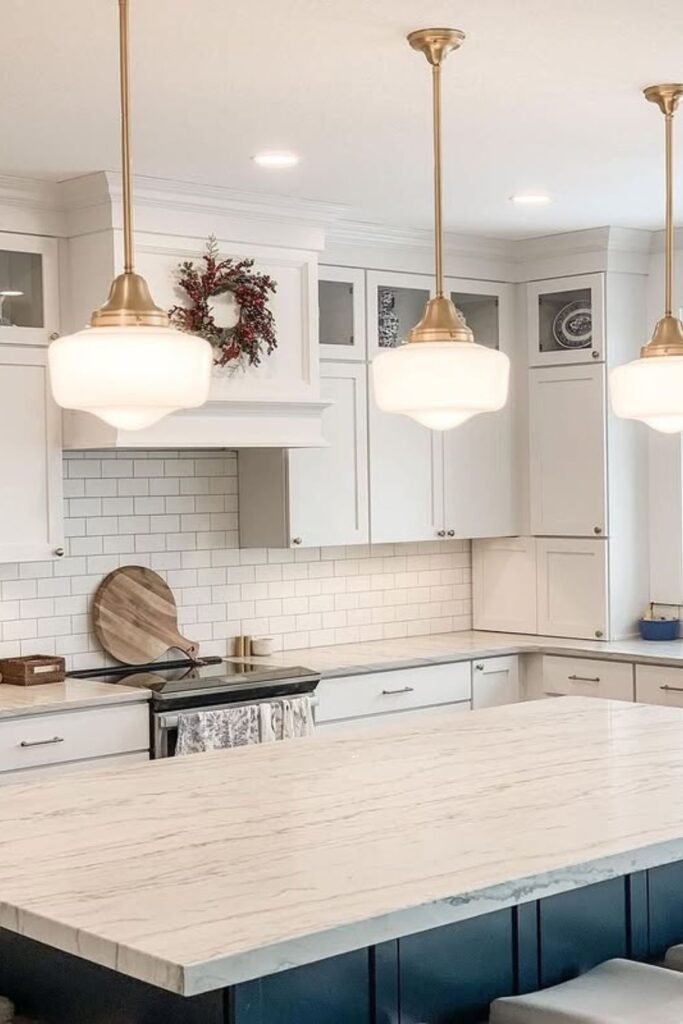
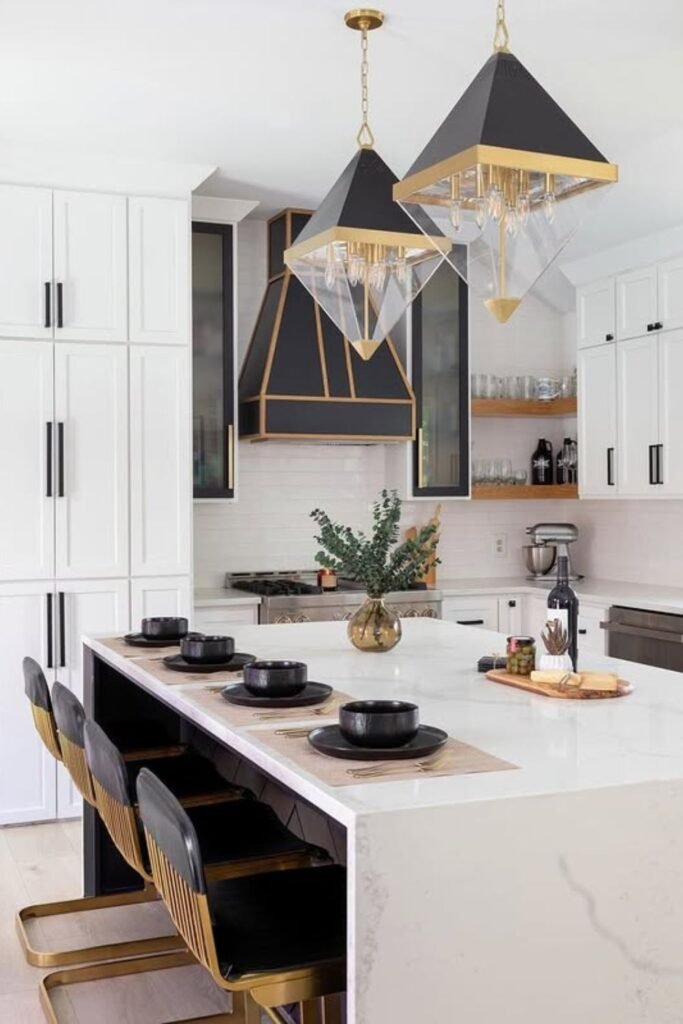
Geometric Drama
Bold fixtures can actually make a kitchen feel more spacious when they’re designed right. These open-frame pendants draw attention upward while still letting light flow freely through the glass panels.
The black and gold contrast adds personality to what could be a plain white kitchen. Sometimes you need one strong element to make everything else feel more intentional.
Hang them high enough to keep sight lines open across the room, especially if your kitchen opens to other areas. The last thing you want is to chop up the view with low-hanging fixtures.
Pair statement pendants with simple recessed lights so the brightness feels balanced. The pendants become the focal point, but they don’t have to do all the work of lighting the room.
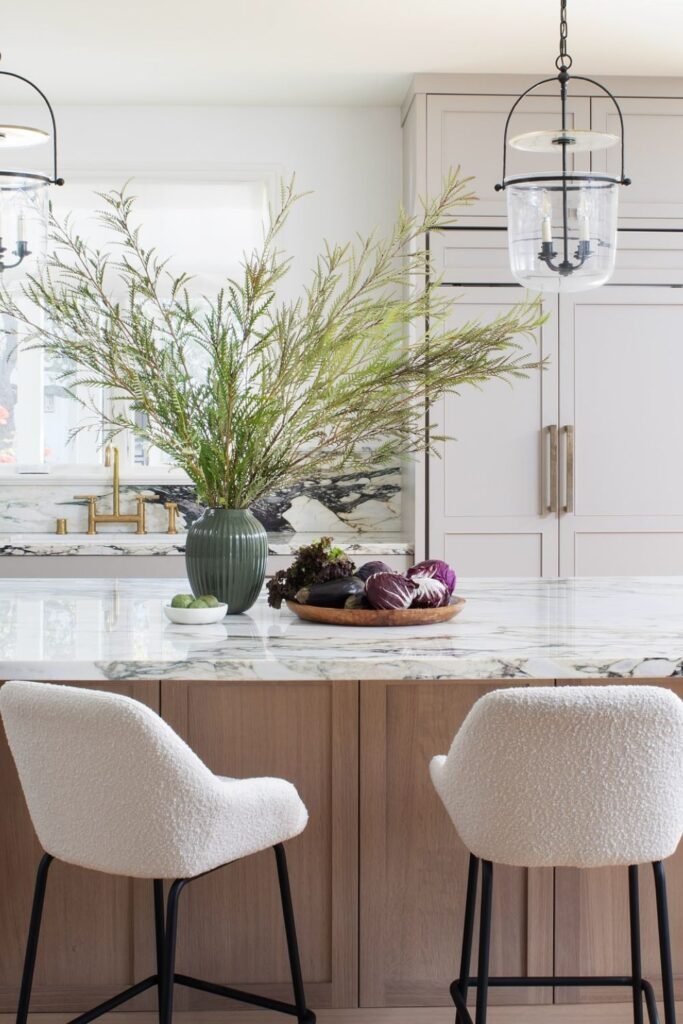
Glass Lanterns
Clear glass keeps your sight lines open, which is half the battle in making a kitchen feel bigger. These lantern-style pendants give you the structure of a traditional fixture without the visual weight.
Light passes right through and reflects off the marble counters, which doubles the brightness without doubling the electricity bill. The black frames add definition against white cabinetry.
If you want substantial lighting that doesn’t make the room feel crowded, this is it. The candle-style bulbs inside give a softer glow than standard LED bulbs.
Space them evenly and keep them centered over the island. Uneven spacing makes everything look like an afterthought, even if the fixtures themselves are beautiful.
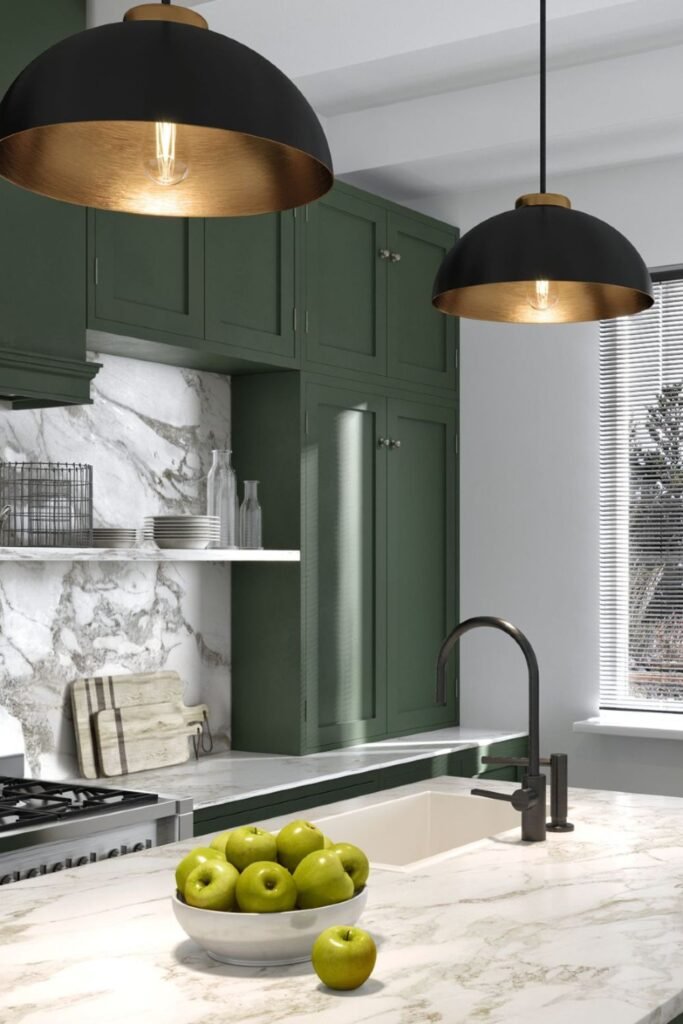
Metallic Contrast
Dark cabinets absorb light, so you need fixtures that push it right back. These matte black pendants with gold interiors do exactly that — the reflective inside surface bounces light down onto the island and back up to the ceiling.
The contrast between the dark green cabinetry and the bright countertops keeps everything from feeling too heavy. Deep colors don’t have to make a space feel small if you balance them properly.
Choose pendants with metallic interiors when you have darker cabinets. The reflective surface amplifies whatever light you’re putting out, which is more efficient than just adding more fixtures.
Warm bulbs are especially important here. Cool white light against dark green looks harsh and industrial.
Save this post for later ❤️
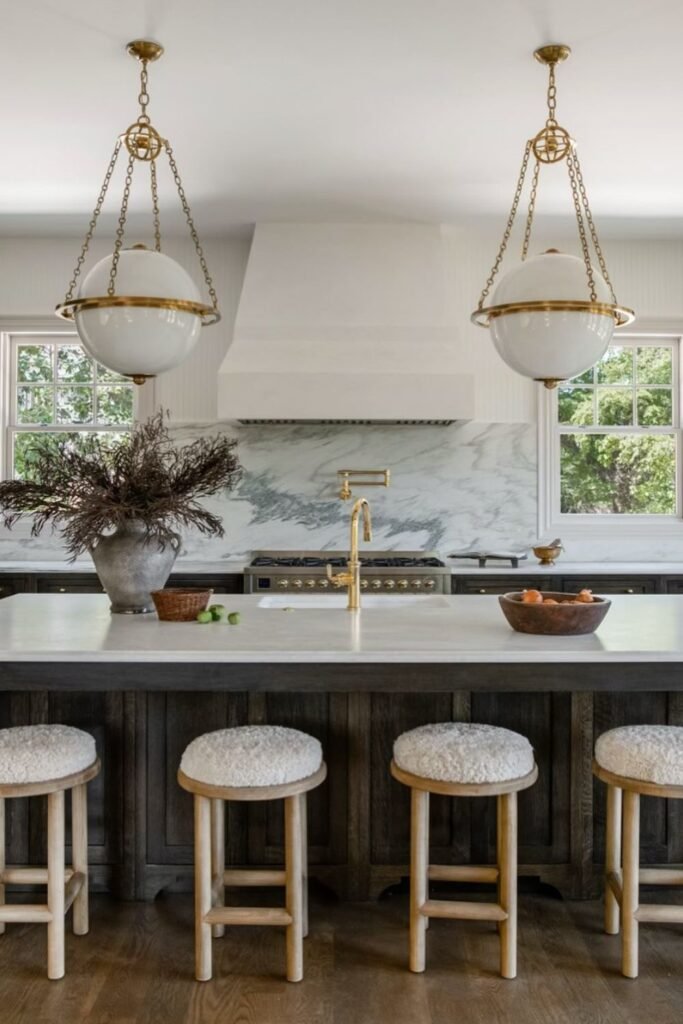
Sculptural Globes
Symmetry makes everything feel more organized and spacious. Two large globe pendants create that balance while keeping the room bright through the white glass.
The brass rings add structure without blocking light, and the size is substantial enough to fill the visual space over a wide island. Sometimes bigger is actually better than more.
For wide islands, two statement fixtures usually look cleaner than three smaller ones. It gives you the same amount of light with less visual clutter.
Mount them at equal height and align them with the island edges. Consistent spacing and placement makes even dramatic fixtures feel calm and intentional.
Linear Elegance
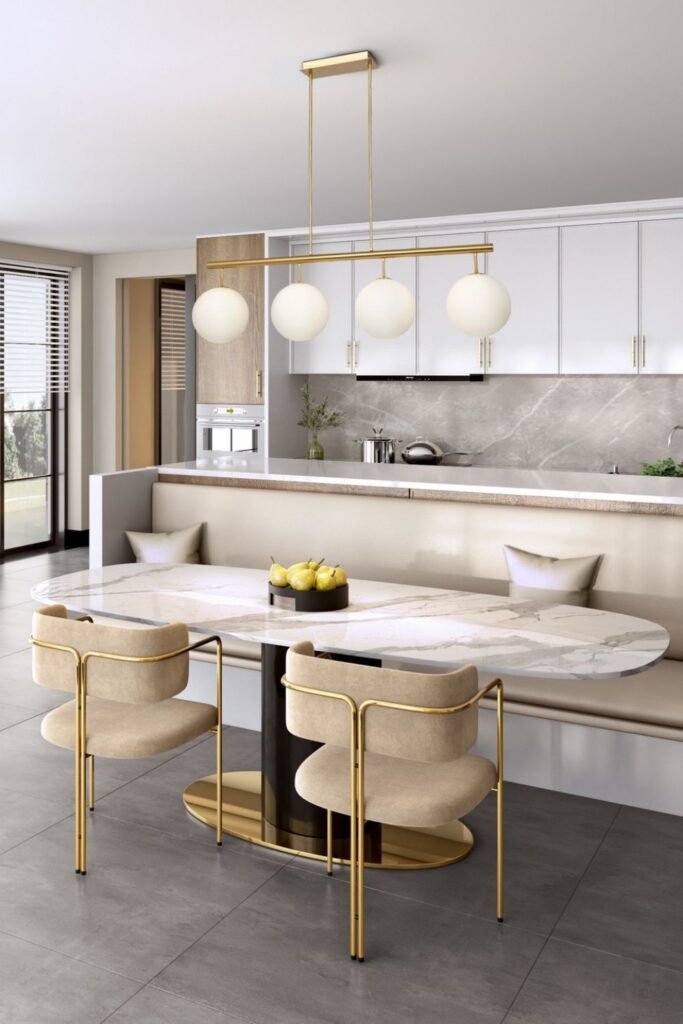
Long islands and dining extensions need lighting that connects them visually instead of breaking them into separate pieces. One linear fixture with multiple lights keeps everything unified.
This works especially well when your kitchen opens to a dining area like this. The horizontal line emphasizes the width of the space, which makes it feel larger.
The slim gold frame adds warmth without bulk, and the frosted globes spread even light across the entire length. No dark spots at the ends where people actually sit.
Choose warm white bulbs and mount it parallel to the counter edge. Keep the drop height consistent so the whole fixture feels balanced and intentional.
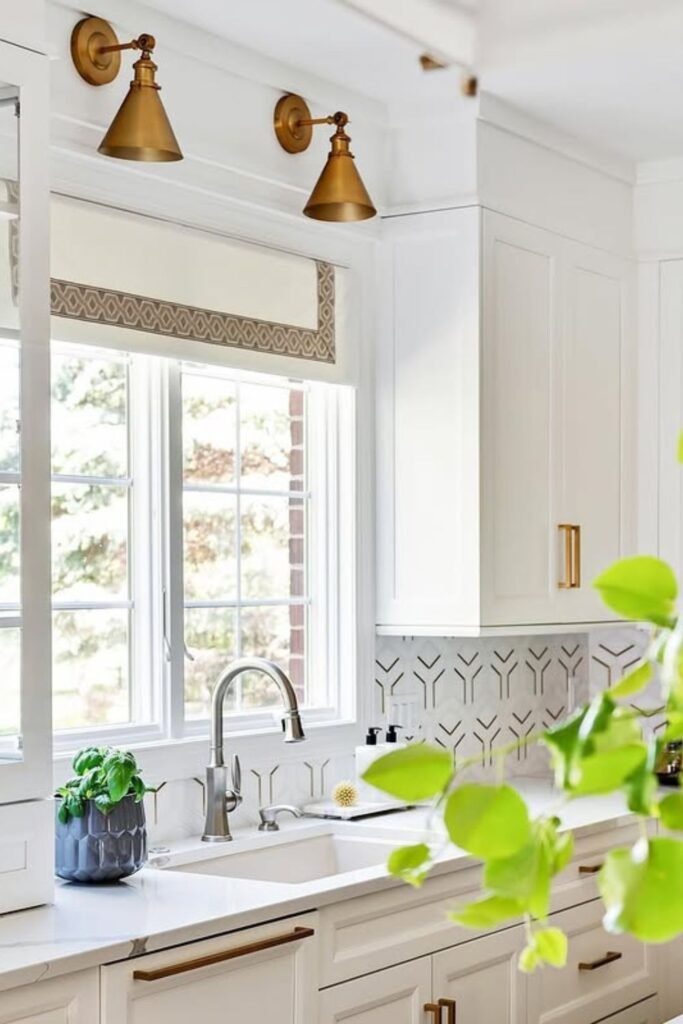
Task Sconces
Sink areas always end up darker than they should be because overhead light casts shadows right where you’re working. Wall sconces solve this by pushing light forward instead of straight down.
These brass sconces above the window trim eliminate shadows on the backsplash and counter without taking up any counter space or hanging in your way.
Install them high enough to avoid glare but low enough to actually light your workspace. If you’re washing dishes or prepping food, you need to see what you’re doing.
Match the finish to your other hardware so everything feels connected. Brass faucet, brass sconces, brass cabinet pulls — it doesn’t have to be complicated to look intentional.
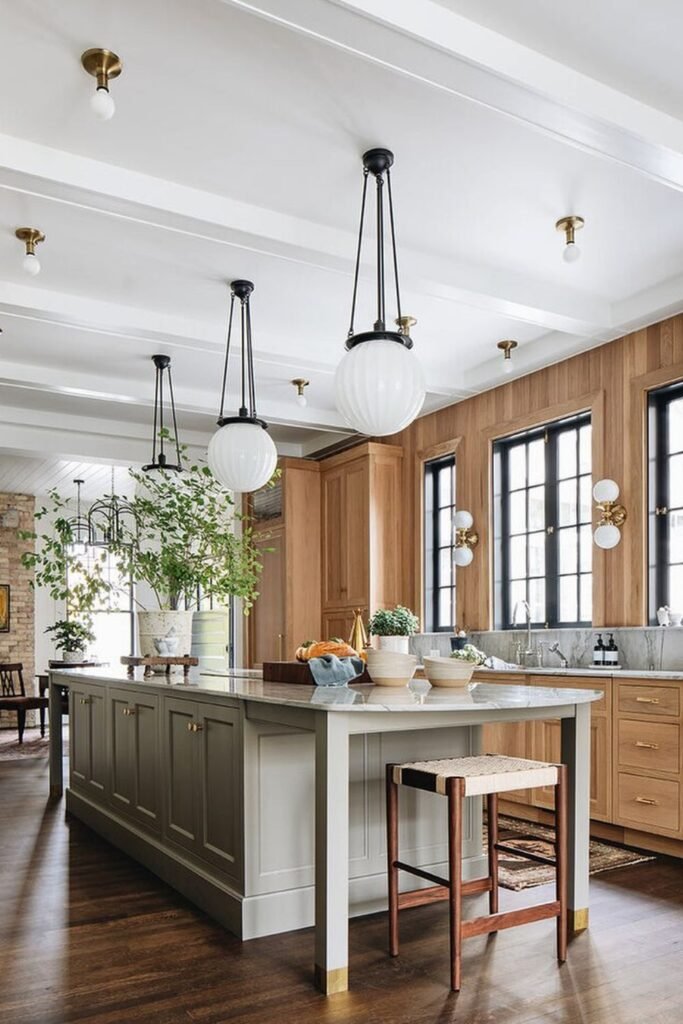
Ceiling Layers
High ceilings can feel empty and dark if you only light them from one level. This kitchen mixes hanging pendants over the island with small flush mounts between the beams.
Light at different heights makes the whole room feel open instead of shadowy. The globe pendants define the workspace while the ceiling-mounted bulbs fill in the gaps.
Wall sconces along the windows brighten the vertical surfaces, which is important in rooms with tall ceilings. You want light hitting the walls, not just the floor.
Keep everything aligned with the architectural lines — beams, windows, cabinet edges. Multiple light sources working together create depth.
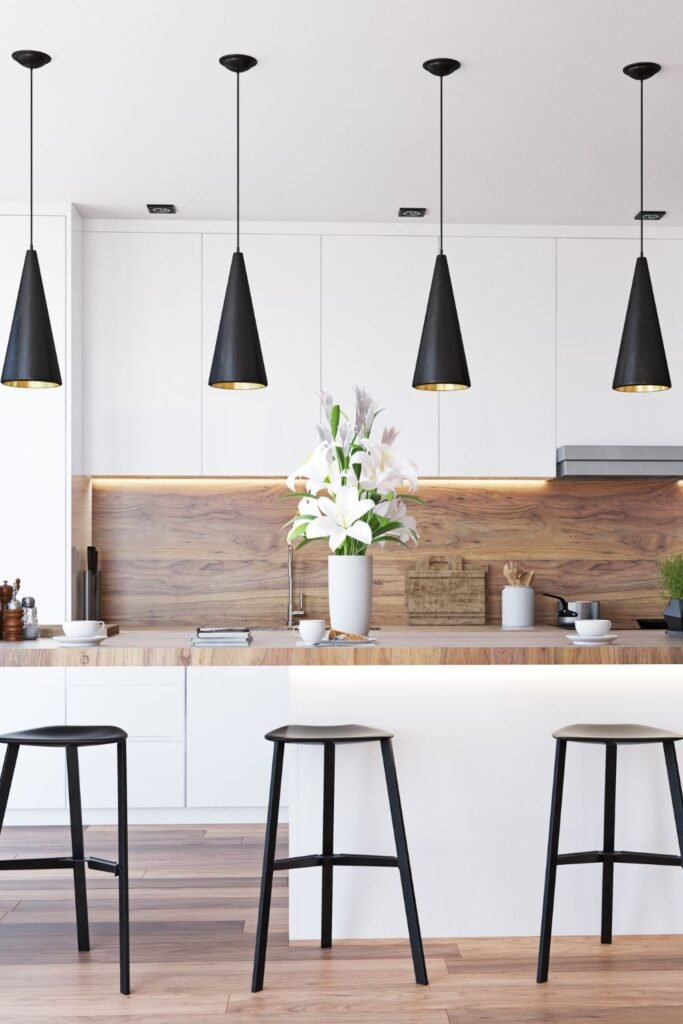
Slim Cones
Clean, modern kitchens can handle more dramatic lighting because there’s less visual competition. These narrow cone pendants direct light straight down onto the island without overwhelming the space.
The matte black exterior adds contrast while the gold interior reflects warmth onto the countertop. Three fixtures lined up evenly create rhythm and balance.
The elongated shape feels more sophisticated than basic dome pendants, but they still keep the focus on the workspace rather than the lighting itself.
Under-cabinet lighting in the background provides the general brightness, so these pendants can focus on being beautiful rather than doing all the work.
Sculpted Line
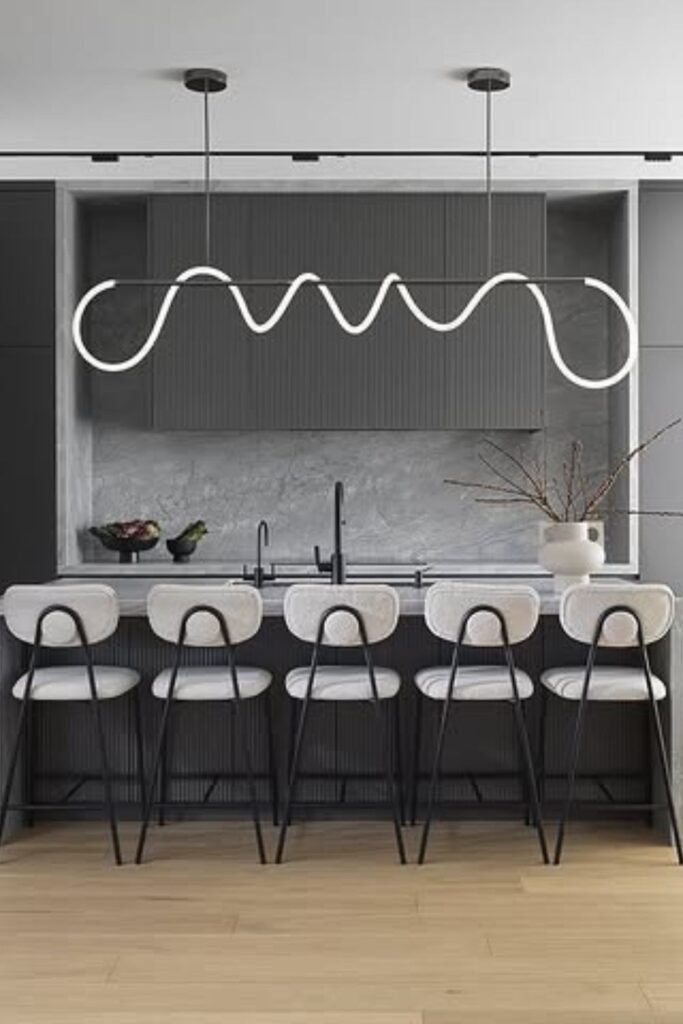
A wave-shaped LED pendant turns ceiling lighting into art while spreading even brightness across the entire island. No one seat is darker than another, which is more practical than it looks.
This type of continuous light source works especially well over long islands where traditional pendants might create uneven coverage.
The thin profile adds drama without blocking sight lines, and the curved shape makes people look up, which instantly makes the ceiling feel higher.
Position it centered and aligned with the cabinetry behind it. Stick with warm white LED so the glow feels inviting rather than clinical.
Artistic Edge
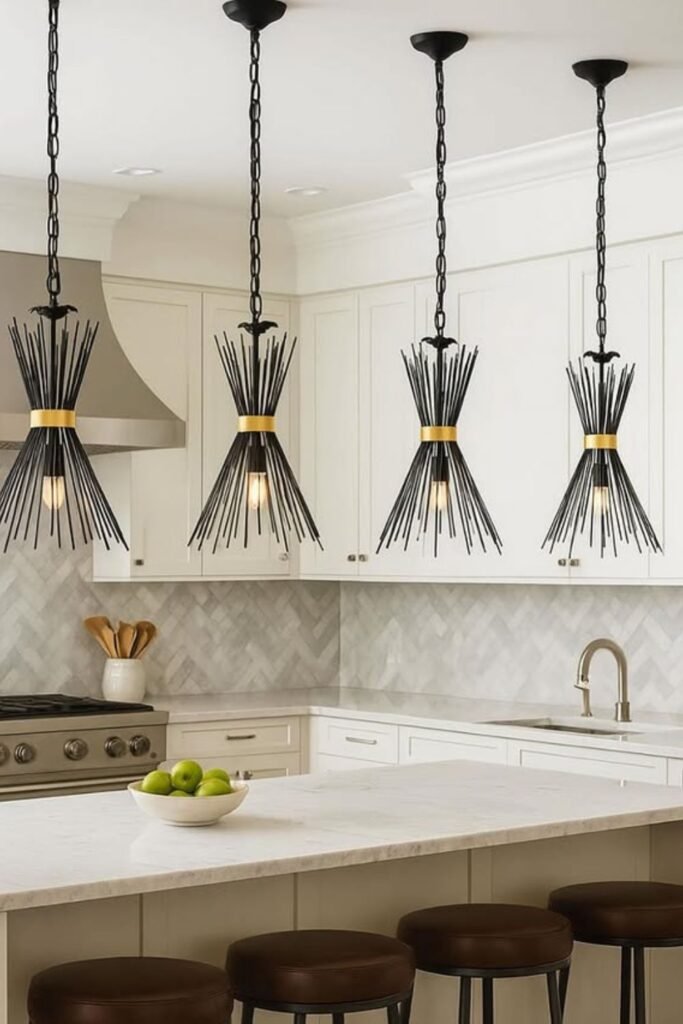
Sometimes your kitchen needs one unexpected element to keep it from feeling boring. These spiked pendants create movement above the island while still letting light flow through the open structure.
The black metal contrasts nicely with white cabinets, and the gold band keeps it from feeling too stark. Bold shapes draw attention upward, which makes the room feel taller.
Leave enough space between each pendant so they don’t compete with each other. The fixtures should feel intentional, not crowded.
Pair dramatic lighting with simple everything else — plain cabinets, neutral counters, minimal hardware. Let the pendants be the feature
Warm Amber
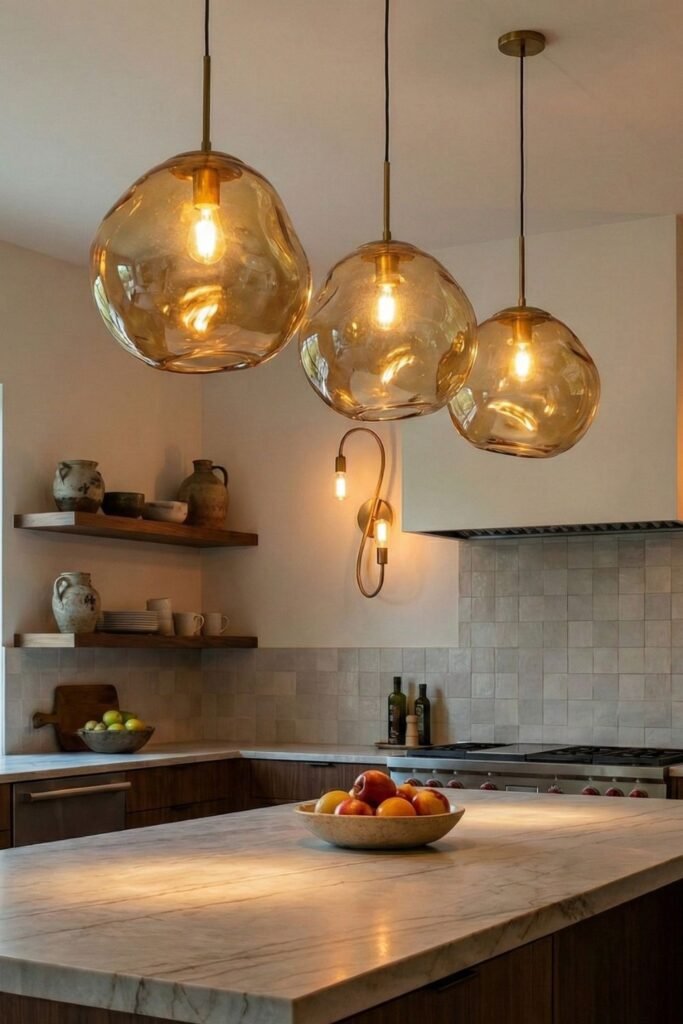
Cool white lighting makes kitchens feel like hospital cafeterias. Amber glass pendants instantly warm up the space and make it feel more inviting.
The tinted glass softens the glow while exposed filament bulbs add texture and character. This works especially well if you have wood cabinets or other natural finishes to complement.
Space them evenly and hang them low enough to anchor the island without blocking views across the room. The matching wall sconces tie everything together and prevent dark spots around the perimeter.
Warm lighting makes people want to linger, which is exactly what you want in a kitchen that opens to your living areas.
Subtle Flush
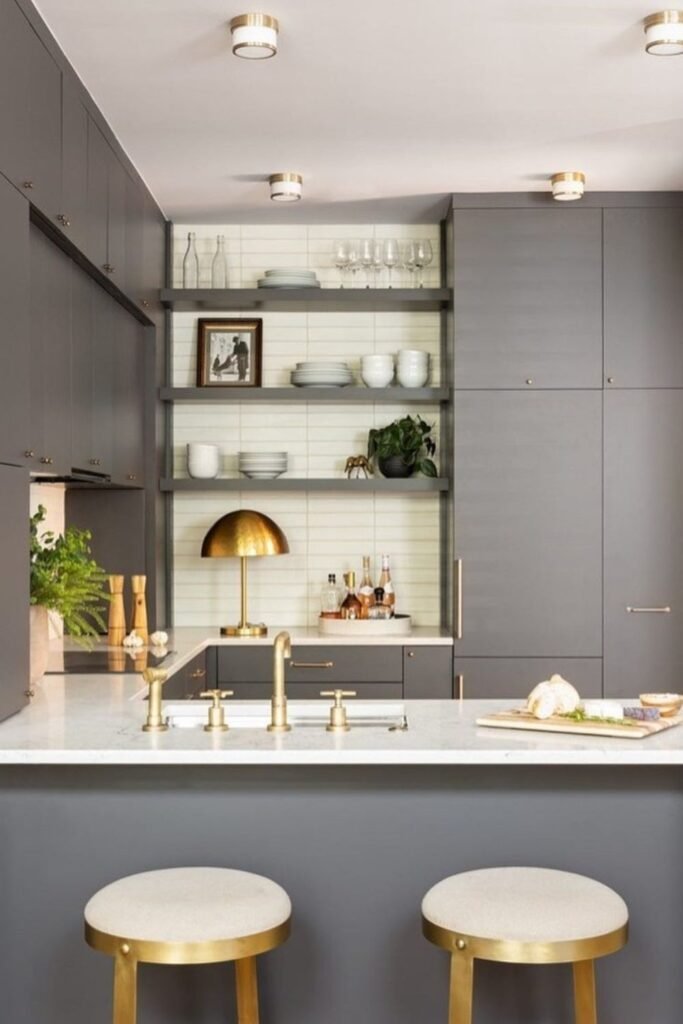
Low ceilings don’t mean you’re stuck with one sad overhead light. Small flush-mount fixtures spread brightness evenly while keeping the ceiling visually clean.
The slim brass detail adds polish without dropping into your sight lines. Gray cabinets can absorb light, so even coverage from above helps prevent shadowy corners that make the room feel smaller.
Install them in a balanced pattern so every area gets adequate brightness. Layer with under-cabinet or accent lighting so the room doesn’t feel flat.
Sometimes the best way to make a space feel bigger isn’t adding more light — it’s choosing lights that stay out of the way.
I’ve spent over four decades building a marriage, raising a family, and learning what truly matters along the way. I write about relationships, home, and navigating life’s later seasons with grace, honesty, and a little humor. My goal is to share the kind of steady, real-life wisdom that helps you feel grounded, encouraged, and a little less alone.